
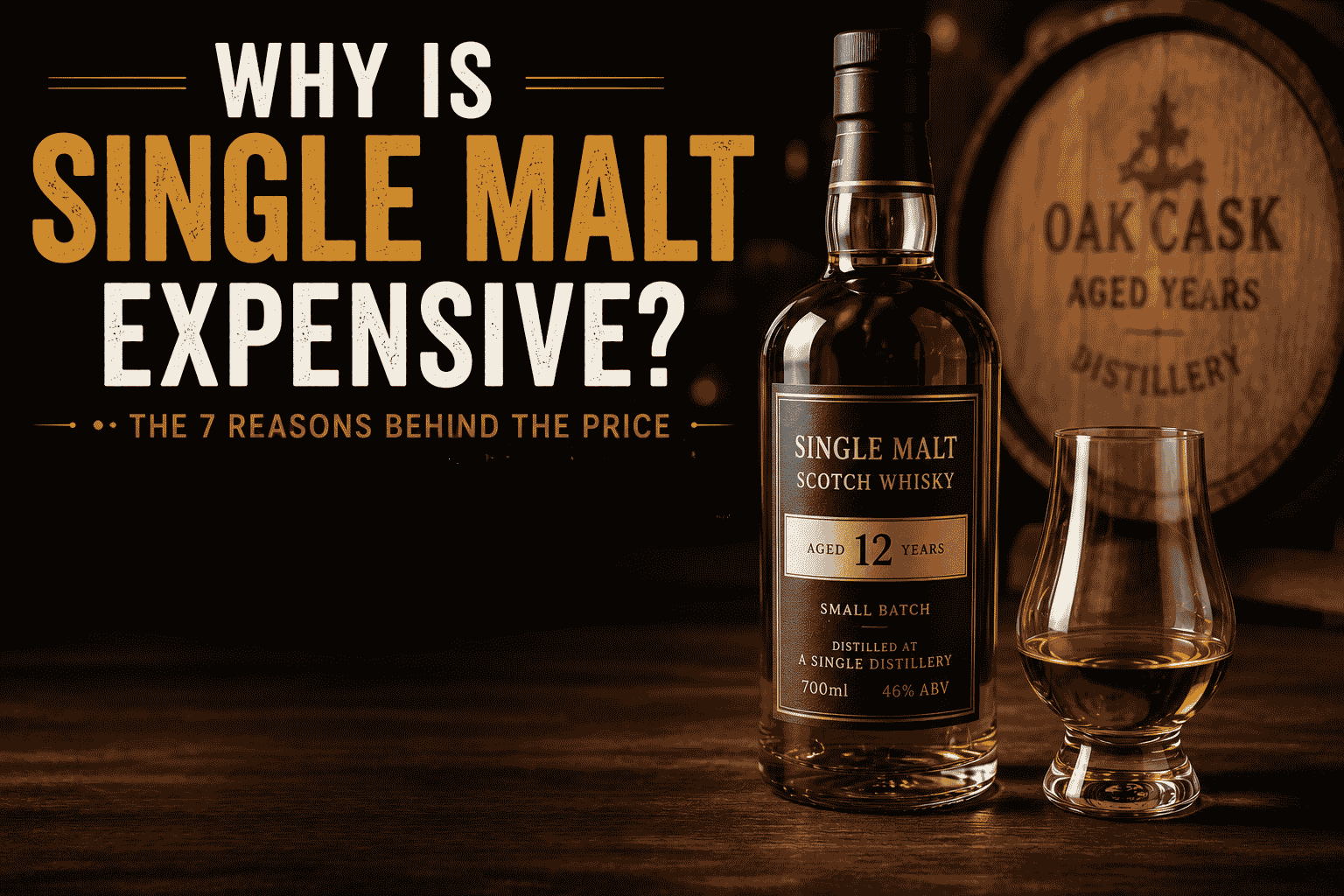
Why Is Single Malt Expensive: If you’ve ever stood in a liquor store comparing bottles, you’ve probably noticed something:
Single malt whisky almost always costs more than blended whisky.
When I first started exploring whisky, I wondered if the higher price was just about branding. But after learning how single malt is made, I realized there’s much more behind the cost.
From premium ingredients and slow production to years of aging in oak barrels, every step adds to the final price.
In this guide, I’ll explain why single malt whisky is expensive in simple, beginner-friendly language.
Why Does Single Malt Cost More?
Single malt whisky takes longer to produce, uses higher-quality ingredients, and spends years maturing before it reaches your glass. During that time, distilleries invest money without earning a return, making the final bottle naturally more expensive.
1. It Comes From a Single Distillery
The term single malt doesn’t mean the whisky comes from one barrel.
It means the whisky is:
- Made at one distillery
- Produced using malted barley
- Distilled in copper pot stills
Unlike blended whisky, producers can’t mix cheaper spirits from different distilleries to reduce costs.
Every bottle reflects the character of a single distillery.
2. It Uses High-Quality Malted Barley
Single malt whisky is made entirely from malted barley.
Compared to grains like corn or wheat, malted barley is generally more expensive to process.
It also requires:
- Careful malting
- Controlled fermentation
- Precise distillation
Using premium raw materials naturally increases production costs.
3. The Aging Process Takes Years
Perhaps the biggest reason for the higher price is time.
Many single malts spend:
- 10 years
- 12 years
- 15 years
- 18 years
- Or even longer
aging inside oak barrels.
During those years, the distillery earns no money from that whisky while continuing to pay for storage, warehouses, insurance, and maintenance.
4. Oak Barrels Are Expensive
Whisky gets much of its flavor from oak casks.
Premium barrels are not cheap.
Many distilleries use:
- Ex-bourbon barrels
- Sherry casks
- Wine casks
- Port casks
Some rare casks can cost several times more than standard barrels.
The quality of the cask greatly influences the whisky’s final flavor, but it also increases production costs.
5. The Angel’s Share Reduces Every Barrel
Each year, some whisky naturally evaporates while aging.
This loss is called the Angel’s Share.
On average:
- Around 2% of the whisky evaporates each year (varies by climate).
After 12 or 18 years, a significant amount of the original spirit has disappeared.
Less whisky remains to sell, making every bottle more valuable.
6. Small Batch Production
Many single malt distilleries produce whisky in relatively small quantities.
Smaller production means:
- Less economy of scale
- Higher production cost per bottle
- Greater focus on quality
Limited releases often become even more expensive because supply is lower than demand.
7. Longer Storage Means Higher Costs
Imagine producing a bottle today but not being able to sell it for 12 years.
That’s exactly what happens with many single malts.
During those years, distilleries must pay for:
- Warehouses
- Staff
- Security
- Barrel maintenance
- Inventory storage
These long-term costs are reflected in the final retail price.
Is Expensive Single Malt Always Better?
Not necessarily.
A higher price often means:
- Longer aging
- Better casks
- Smaller production
- Greater complexity
However, taste is personal.
Many affordable single malts deliver excellent quality and may suit your palate better than bottles costing several times more.
Why Blended Whisky Is Usually Cheaper
Blended whisky combines spirits from multiple distilleries.
This gives producers greater flexibility to:
- Maintain consistent flavor
- Produce larger volumes
- Control production costs
That’s why blended whiskies are often much more affordable than single malts.
Is Single Malt Worth the Money?
If you enjoy exploring flavors and aromas, many people find single malt worth the extra cost.
Single malts often offer:
- More complexity
- Richer aromas
- Greater depth
- A unique distillery character
For casual drinking, however, a good blended whisky can provide excellent value.
Quick Comparison
| Feature | Single Malt | Blended Whisky |
|---|---|---|
| Distillery | One | Multiple |
| Main Grain | 100% Malted Barley | Mix of malt and grain whiskies |
| Production | Smaller batches | Large-scale production |
| Aging | Often longer | Varies |
| Flavor | Rich and complex | Smooth and approachable |
| Price | Usually higher | Usually lower |
Single malt whisky is expensive for good reasons.
It’s made from premium malted barley, produced at a single distillery, aged for years in quality oak casks, and loses part of its volume to the Angel’s Share before it ever reaches the bottle.
That doesn’t mean you need to spend a fortune to enjoy whisky. There are many reasonably priced single malts that offer exceptional quality and are perfect for beginners.
Understanding what goes into every bottle makes it easier to appreciate why single malt often commands a higher price.
Frequently Asked Questions (FAQs)
Why is single malt whisky more expensive than blended whisky?
Single malt is made at one distillery using 100% malted barley and is often aged longer in premium oak casks. The slower production process and lower output increase its cost.
Does older single malt always cost more?
Generally, yes. Older whiskies require more years of storage and lose more volume to evaporation, making them more expensive. However, age alone doesn’t guarantee better taste.
Why do oak barrels make whisky expensive?
Oak casks are costly to source and have a major impact on the whisky’s flavor. Premium casks, such as ex-sherry or wine barrels, can significantly increase production costs.
What is the Angel’s Share?
The Angel’s Share is the portion of whisky that naturally evaporates while it matures in oak barrels. This reduces the amount of whisky available for bottling.
Is single malt worth buying?
If you enjoy rich, complex flavors and want to explore different distillery styles, single malt can be worth the extra cost. If you’re looking for value and easy-drinking whisky, a quality blended whisky is also an excellent choice.







Add comment