
How Whisky Is Made: Have you ever looked at a bottle of whisky and wondered, “How is whisky actually made?”
When I first got interested in whisky, I thought it was simply fermented grain poured into a bottle. But the process is far more fascinating. From selecting grains to years of aging in oak barrels, every step shapes the whisky’s final flavor, aroma, and character.
In this guide, I’ll explain how whisky is made step by step in simple language, so even if you’re completely new to whisky, you’ll understand how your favorite bottle comes to life.
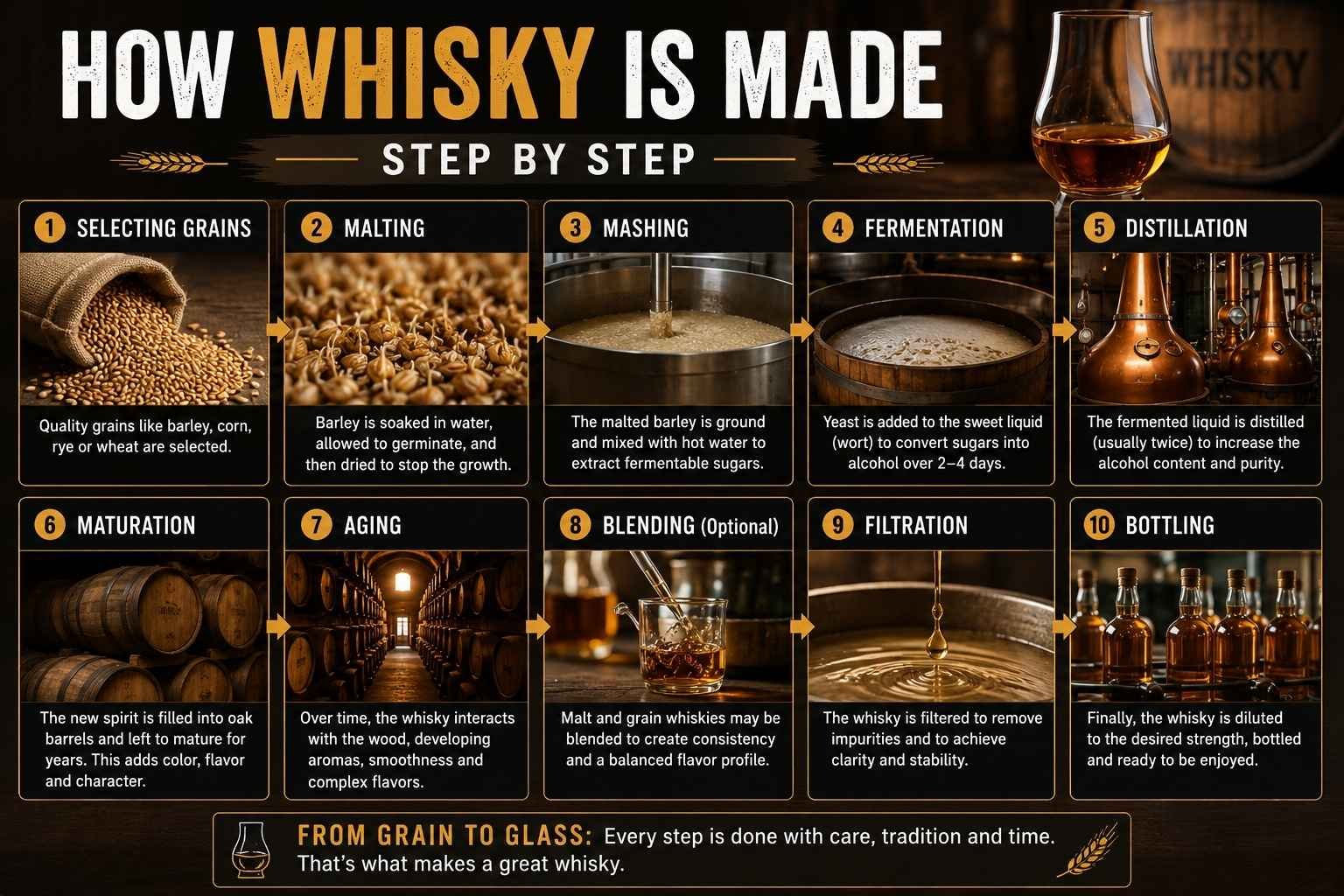
Whisky Making Process at a Glance
| Step | Process | Purpose |
|---|---|---|
| 1 | Grain Selection | Choose the base ingredient |
| 2 | Malting | Prepare grains for sugar extraction |
| 3 | Mashing | Convert starch into fermentable sugars |
| 4 | Fermentation | Produce alcohol |
| 5 | Distillation | Increase alcohol purity |
| 6 | Maturation | Develop flavor and color |
| 7 | Blending (Optional) | Create consistency |
| 8 | Bottling | Prepare whisky for sale |
Step 1: Selecting the Grains
Everything starts with grains.
Different types of whisky use different grains, and each one contributes its own flavor profile.
The most common grains include:
- Barley
- Corn
- Rye
- Wheat
For example:
- Scotch whisky mainly uses malted barley.
- Bourbon uses mostly corn.
- Rye whisky uses a high percentage of rye grain.
The choice of grain is one of the biggest factors that determines how the whisky will taste.
Step 2: Malting
If barley is being used, it usually goes through a process called malting.
Here’s what happens:
- The barley is soaked in water.
- It begins to germinate (sprout).
- Once enough natural enzymes develop, the germination is stopped by drying the grain with warm air.
Some distilleries dry the barley over peat fires, which gives certain Scotch whiskies their famous smoky flavor.
After drying, the malt is ready for the next stage.
Step 3: Mashing
The dried malt is then ground into a coarse flour called grist.
The grist is mixed with hot water inside a large vessel called a mash tun.
During this process:
- Natural enzymes convert starch into sugar.
- A sweet liquid is produced.
- This sugary liquid is known as wort.
The leftover grain is often reused as animal feed.
Step 4: Fermentation
The wort is transferred into large fermentation tanks.
Yeast is then added.
The yeast feeds on the sugar and produces:
- Alcohol
- Carbon dioxide
- Fruity flavor compounds
This stage usually lasts between 48 and 96 hours.
At the end of fermentation, the liquid contains around 6–10% alcohol, similar to a strong beer.
Step 5: Distillation
The fermented liquid now enters copper stills.
The purpose of distillation is to:
- Increase alcohol concentration
- Remove unwanted compounds
- Refine the spirit
Most Scotch whisky is distilled twice.
Some Irish whiskeys are distilled three times, producing an even smoother spirit.
After distillation, the clear liquid is called new make spirit.
At this stage, it has no amber color yet.
Step 6: Maturation in Oak Barrels
This is where whisky becomes whisky.
The new spirit is filled into oak casks.
During maturation:
- The spirit absorbs flavors from the wood.
- It develops its golden or amber color.
- Harsh alcohol notes soften.
- Complex aromas appear over time.
Depending on the whisky style, barrels may previously have held:
- Bourbon
- Sherry
- Wine
- Rum
Every cask adds different flavors.
Why Oak Barrels Matter
Around 60–80% of a whisky’s final flavor comes from the barrel during aging.
Common flavor notes include:
- Vanilla
- Caramel
- Honey
- Coconut
- Dried fruits
- Spice
- Chocolate
- Oak
Without oak maturation, whisky would remain a clear spirit with a much simpler taste.
Step 7: Blending (Optional)
Not every whisky is blended.
Single malt whisky comes from one distillery.
Blended whisky combines spirits from multiple distilleries to achieve:
- Consistent flavor
- Better balance
- Affordable pricing
Master blenders spend years perfecting these recipes.
Step 8: Bottling
Before bottling, the whisky may be:
- Filtered
- Diluted to bottling strength
- Left at natural color or caramel coloring may be added (depending on the producer)
Most whiskies are bottled between 40% and 46% ABV, although cask-strength bottles can exceed 55–60% ABV.
Once bottled, the whisky is ready to be enjoyed.
How Long Does Whisky Take to Make?
The complete process varies depending on the style of whisky.
| Stage | Approximate Time |
|---|---|
| Malting | 5–7 days |
| Mashing | 4–8 hours |
| Fermentation | 2–4 days |
| Distillation | 1 day |
| Maturation | Minimum 3 years (Scotch) |
| Bottling | 1 day |
Premium whiskies may spend 10, 12, 15, 18, or even 25+ years aging before release.
Does Older Whisky Always Taste Better?
Not necessarily.
While longer aging often adds complexity, it doesn’t guarantee a better whisky.
Many excellent whiskies are aged between 10 and 15 years, while some younger expressions deliver outstanding flavor thanks to quality casks and careful production.
The quality of the barrel, climate, and distillation process all play important roles.
Interesting Facts About Whisky Making
- Whisky is completely clear after distillation—the amber color comes from the oak cask.
- Around 2% of whisky evaporates from the barrel each year, known as the Angel’s Share.
- Copper stills help remove unwanted sulfur compounds, contributing to a cleaner spirit.
- Every distillery has its own yeast strains, still shapes, and production methods that create a unique flavor profile.
Making whisky is a slow process that combines science, craftsmanship, and patience.
From selecting grains and fermenting sugars to distilling the spirit and aging it for years in oak barrels, every step influences the final bottle you pour into your glass.
Now that you know how whisky is made step by step, you’ll have a greater appreciation for the time, care, and tradition behind every sip.
Frequently Asked Questions (FAQs)
What are the basic steps in making whisky?
The main steps are grain selection, malting, mashing, fermentation, distillation, maturation in oak barrels, optional blending, and bottling.
Why is whisky aged in oak barrels?
Oak barrels add color, aroma, and flavors such as vanilla, caramel, spice, and dried fruit while also softening the spirit over time.
How long must Scotch whisky be aged?
Scotch whisky must mature in oak casks for at least three years before it can legally be called Scotch whisky.
Why is whisky clear before aging?
Freshly distilled spirit is naturally clear. The golden or amber color develops as the whisky matures in oak barrels.
Can whisky continue aging in the bottle?
No. Once bottled, whisky stops aging. Unlike wine, its flavor remains largely unchanged as long as the bottle is stored properly.





Add comment