
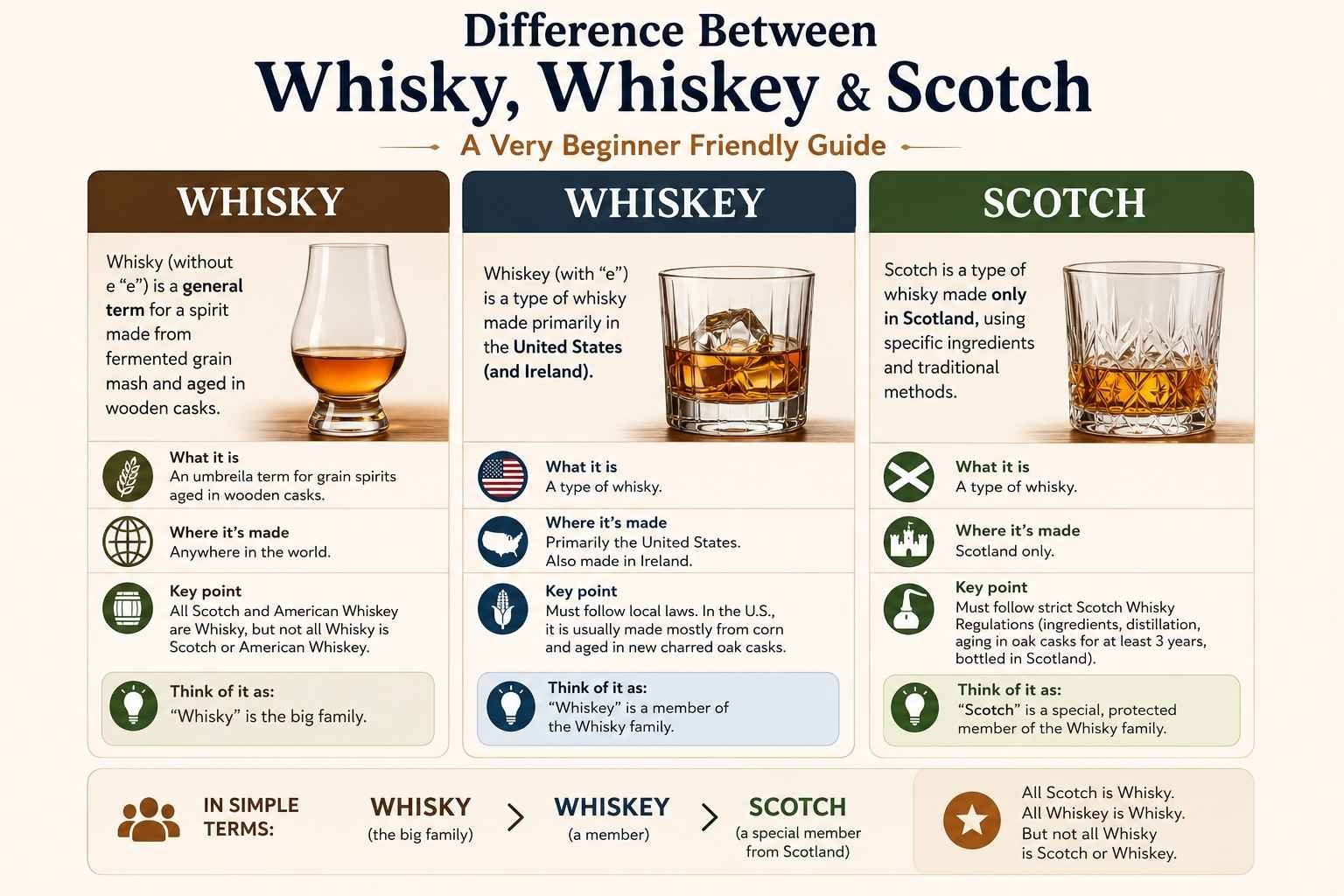
Difference Between Whisky, Whiskey & Scotch: If you’ve recently started exploring the world of premium spirits, you’ve probably noticed that some bottles are labeled “whisky,” others say “whiskey,” and certain brands proudly call themselves “Scotch.” This often leaves beginners wondering whether these terms refer to completely different drinks or simply different ways of spelling the same thing.
The truth is that while all Scotch is whisky, not all whisky is Scotch. The spelling difference between whisky and whiskey also has historical roots rather than indicating a major difference in taste.
Understanding these distinctions can help you choose the right bottle and avoid confusion the next time you’re shopping for your favorite drink.
In this guide, we’ll explain the differences between whisky, whiskey, and Scotch in simple terms.
Quick Comparison Table of Difference Between Whisky, Whiskey & Scotch
| Feature | Whisky | Whiskey | Scotch |
|---|---|---|---|
| Meaning | General term for distilled grain spirit | General term used in certain countries | Whisky made in Scotland |
| Spelling Used In | Scotland, India, Japan, Canada | Ireland, United States | Scotland |
| Main Ingredients | Varies by country | Varies by country | Water, malted barley (and other grains in some styles) |
| Country Requirement | No | No | Must be produced in Scotland |
| Aging Rules | Depends on local laws | Depends on local laws | Minimum 3 years in oak casks |
What Is Whisky?
Whisky is a broad category of distilled alcoholic beverages made from fermented grain mash.
The grains used can include:
- Barley
- Corn
- Rye
- Wheat
The production methods and regulations differ depending on the country where the whisky is made.
Countries famous for producing whisky include:
- Scotland
- India
- Japan
- Canada
Examples:
- Glenfiddich 12 Years
- Indri Trini
- Paul John Brilliance
- Canadian Club
In simple terms:
Whisky is the general term used for grain-based distilled spirits that have been matured according to their country’s regulations.
What Is Whiskey?
Whiskey refers to essentially the same type of spirit but uses a different spelling.
The spelling “whiskey“ is commonly used in:
- Ireland
- United States
Examples include:
- Jameson Irish Whiskey
- Jack Daniel’s Old No. 7 Tennessee Whiskey
- Maker’s Mark Bourbon Whiskey
The difference is mainly historical.
During the 19th century, Irish producers adopted the spelling “whiskey” to distinguish their products from Scottish whisky. American producers later followed the Irish convention.
Therefore:
Whisky and whiskey are largely the same category of spirit, but the spelling often reflects the country of origin.
What Is Scotch?
Scotch is a specific type of whisky.
For a whisky to legally be called Scotch, it must meet strict requirements.
Scotch Must Be:
- Produced in Scotland
- Matured in oak casks for at least three years
- Distilled and matured entirely within Scotland
- Bottled at a minimum of 40% alcohol by volume
If a whisky is made outside Scotland, it cannot be labeled as Scotch.
Examples of Scotch whiskies include:
- Johnnie Walker Black Label
- Chivas Regal 12 Years
- Glenlivet 12 Years
- Talisker 10 Years
This means:
All Scotch is whisky, but not all whisky is Scotch.
Why Are There Different Spellings?
The spelling difference is mostly based on geography.
| Country | Common Spelling |
|---|---|
| Scotland | Whisky |
| India | Whisky |
| Japan | Whisky |
| Canada | Whisky |
| Ireland | Whiskey |
| United States | Whiskey |
There is no rule stating that one spelling is superior to the other.
Instead, the spelling often gives you a clue about where the spirit was produced.
Does Whisky Taste Different From Whiskey?
Not necessarily.
The taste depends more on:
- Ingredients used
- Distillation methods
- Aging process
- Type of casks
- Climate
For example:
A smoky Scotch like Talisker 10 tastes very different from a sweet Irish whiskey like Jameson.
Similarly, a rich Indian single malt like Indri Trini differs significantly from a bourbon-style American whiskey.
The spelling itself does not determine flavor.
Different Types of Scotch Whisky
Scotch itself can be divided into several categories.
Single Malt Scotch
Produced from malted barley at a single distillery.
Examples:
Blended Scotch
A combination of malt and grain whiskies from different distilleries.
Examples:
- Johnnie Walker Black Label
- Chivas Regal 12
Single Grain Scotch
Produced at a single distillery but may include grains other than barley.
Blended Malt Scotch
A blend of single malts from multiple distilleries.
Example:
- Monkey Shoulder
Which One Should Beginners Choose?
If you’re new to whisky, the choice depends on your preferences.
Choose Scotch if:
- You want to explore classic whisky styles.
- You enjoy balanced and refined flavors.
- You’re interested in single malts.
Choose Irish Whiskey if:
- You prefer lighter and smoother profiles.
- You want an approachable introduction.
Choose Indian Whisky if:
- You enjoy bold flavors.
- You want excellent value for money.
There is no “best” category—only what suits your palate.
Common Misconceptions
Myth 1: Scotch and whisky are different drinks.
False.
Scotch is simply a type of whisky made in Scotland.
Myth 2: Whiskey is stronger than whisky.
False.
Alcohol content varies by brand and expression.
Myth 3: Single malt means better quality.
Not always.
Blended whiskies can also offer exceptional quality and consistency.
The terms whisky, whiskey, and Scotch often confuse beginners, but the distinction is simpler than it appears.
- Whisky is the general term commonly used in countries like Scotland, India, Japan, and Canada.
- Whiskey is the preferred spelling in Ireland and the United States.
- Scotch is whisky that is produced and matured in Scotland according to strict legal standards.
Understanding these differences won’t automatically make you a whisky expert, but it will certainly help you navigate bottles with greater confidence.
As you continue exploring the whisky world, remember that the most important factor isn’t the spelling on the label—it’s finding a style that you genuinely enjoy drinking responsibly.
Frequently Asked Questions (FAQs)
Is whisky the same as whiskey?
Yes. They refer to the same category of spirit, but the spelling usually depends on the country of origin.
Why is Scotch called Scotch?
Because it is whisky produced in Scotland under specific legal regulations.
Is Jack Daniel’s a whisky or whiskey?
Jack Daniel’s is labeled as Tennessee Whiskey and follows the American spelling convention.
Is Jameson Scotch?
No. Jameson is an Irish whiskey produced in Ireland.
Is Indian whisky considered Scotch?
No. Indian whisky cannot be called Scotch because it is not produced and matured in Scotland. However, Indian single malts such as Indri, Amrut, and Paul John have gained international recognition for their quality.



Add comment